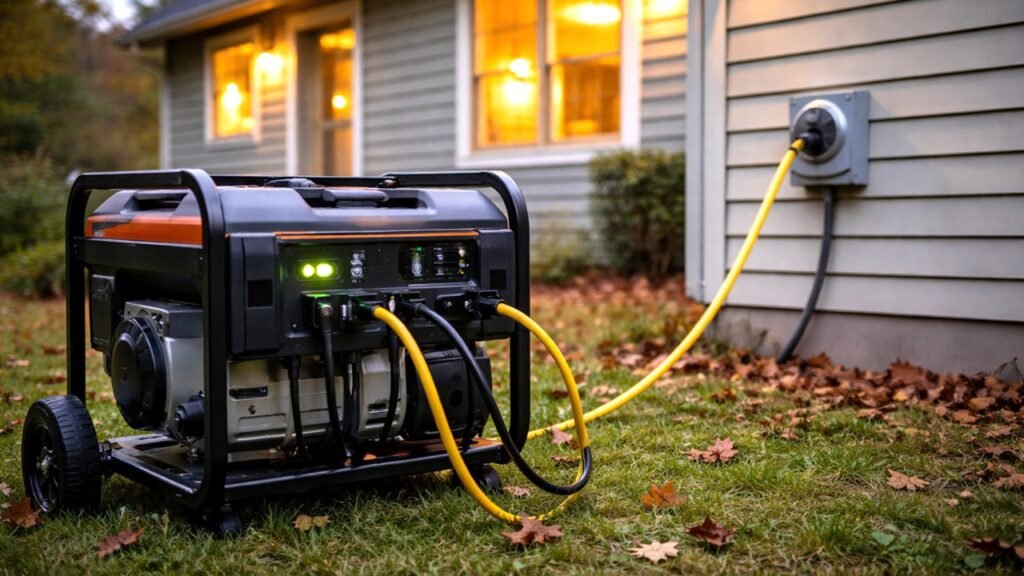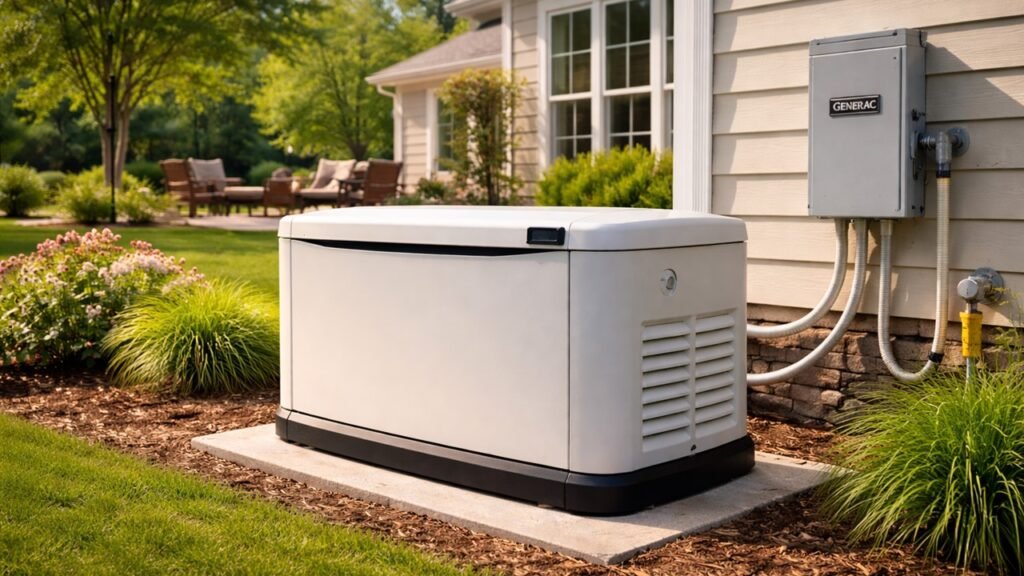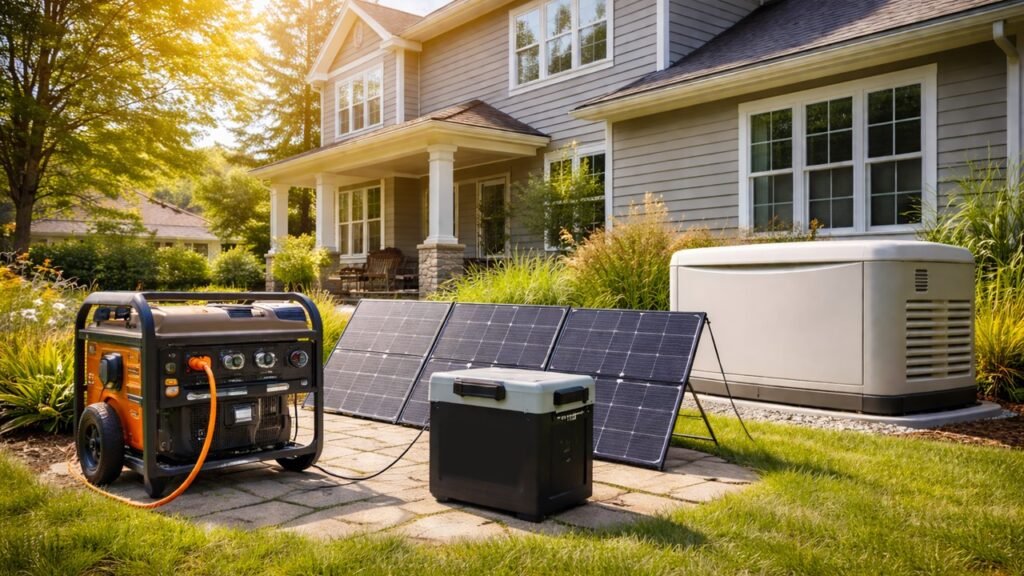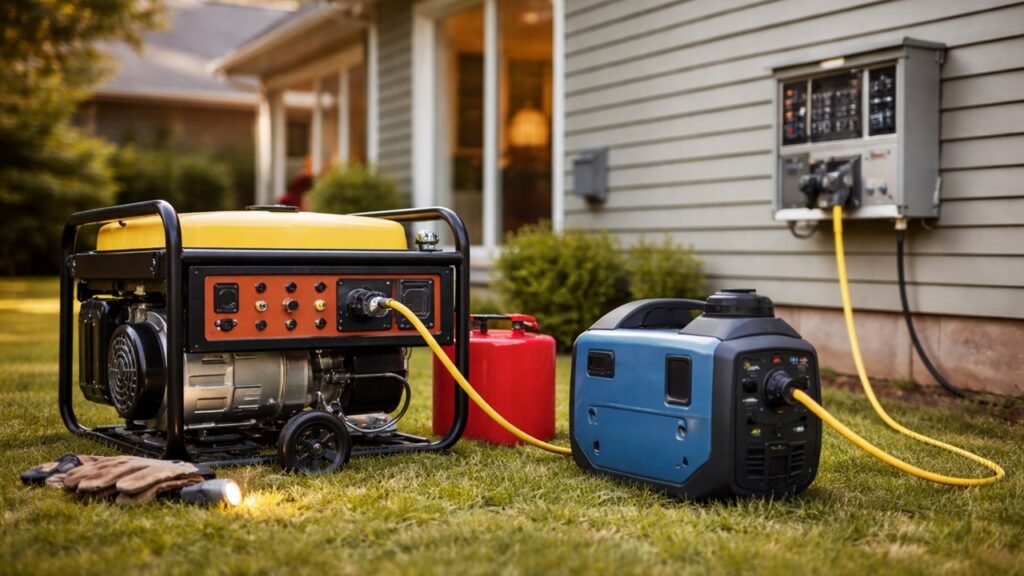
If you’re wondering how many watt generator to run a house, most homes need 5,000 to 9,500 watts for essentials during an outage. Full whole-house backup with central air conditioning usually requires 15,000 to 25,000 watts or more, depending on what runs at the same time.
This guide shows you how to estimate your real power needs, calculate running and starting watts, and choose the right generator size without overspending or overloading.
Key Summary:
- Most homes require 5,000 to 9,500 watts to run essential appliances during a power outage.
- Whole-house backup systems typically require 15,000 to 25,000+ watts when central air conditioning and electric heating are included.
- Generator sizing requires adding total running watts and the highest starting watt load.
- Starting watts from motor-driven appliances often equal 2 to 3 times their running watts.
- A 20 percent safety buffer prevents overload and improves long-term generator performance.
How Many Watts Do You Need To Run A House?
Most homes need 5,000 to 9,500 watts to run essential appliances during a power outage. Larger homes with central air conditioning and electric water heating often require 15,000 to 25,000+ watts for full coverage.
The wattage you need depends on how much of your house you want to power:
- 2,000 to 4,500 watts: Refrigerator, lights, WiFi, chargers, and small electronics
- 5,000 to 9,500 watts: Essentials plus furnace fan, sump pump, microwave, and well pump
- 12,000 to 15,000 watts: Most circuits in a small to mid-size home, partial HVAC use
- 20,000 to 25,000+ watts: Central AC, electric water heater, kitchen appliances, laundry, and full-home backup
Motor-driven appliances such as refrigerators, air conditioners, and pumps require extra power at startup. This surge load must be included when sizing your generator.
What Size Generator Do I Need Based On Home Size?
For most homes, generator size increases with square footage and appliance load. A 1,500 sq ft home typically needs a 10 to 12 kW generator, while a 2,000 sq ft home often requires 16 to 20 kW for whole-home reliability.
| Home Size | Typical Wattage Needed | Recommended Generator Size |
| 1,000 to 1,200 sq ft | 5,000 to 7,500 W | 7 to 10 kW |
| 1,500 sq ft | 6,000 to 9,000 W | 10 to 12 kW |
| 2,000 sq ft | 12,000 to 15,000 W | 16 to 20 kW |
| 2,500 to 3,000 sq ft | 15,000 to 20,000 W | 20 to 25 kW |
| 3,000+ sq ft | 20,000+ W | 25 kW+ |
Square footage provides a helpful starting estimate, but the true deciding factors are heating type, air conditioning size, and whether major appliances run on electricity. Always calculate your actual running watts and account for starting watts before choosing a generator size.
How Do You Calculate The Exact Generator Size For Your Home?
To calculate the exact generator size for your home, add up the running watts of the appliances you want to power, add the highest starting watt requirement, then include a 20 percent safety buffer. That final number tells you the minimum generator capacity you should look for.
Here’s how to do it step by step.
Step 1: List What You Want To Power
Start simple. Write down the appliances and systems you absolutely want running during an outage.
Common essentials include:
- Refrigerator and freezer
- Lights
- Furnace fan or heating system
- Central AC or window unit
- Sump pump or well pump
- WiFi router and modem
- Microwave
- Medical equipment
Be realistic. If you plan to run everything as normal, include everything. If you are okay managing loads, only list essentials.
Step 2: Add Total Running Watts
Every appliance has a running watt rating. This is the power it uses once it is operating normally. You can find it on the label, in the manual, or on the manufacturer’s website.
Add the running watts of all the appliances you plan to run at the same time. This gives you your base load.
Step 3: Add The Highest Starting Watts
Some appliances need extra power when they start. This is called surge or starting watts. Motors and compressors are the main ones to watch:
- Refrigerators
- Air conditioner
- Well pumps
- Sump pumps
You do not add all starting watts together. You only add the highest single surge load on top of your total running watts.
Step 4: Add A 20 Percent Safety Buffer
Once you have your total, multiply it by 1.2. This gives you breathing room and prevents overload.
Formula:
Minimum Generator Size in kW: (Total Running Watts × 1.2) ÷ 1,000
That final number is the generator size you should shop for.
What Are The Running And Starting Watts Of Common Appliances?
Running watts are the continuous power an appliance uses. Starting watts are the extra burst of power needed when it first turns on. Motor-driven appliances usually require two to three times more power at startup.
Here are typical household averages.
| Appliance | Running Watts | Starting Watts |
| Refrigerator | 700 W | 2,200 W |
| Central AC 3 ton | 3,500 W | 7,000 W |
| Furnace fan | 800 W | 1,600 W |
| Sump pump | 800 W | 1,300 W |
| Electric water heater | 4,000 W | 4,000 W |
| Microwave | 1,000 W | 1,000 W |
| Lights 10 total | 1,000 W | 1,000 W |
| WiFi router | 15 W | 15 W |
Actual numbers vary by model, but this gives you a solid starting point for planning.
Will A 5,000 Watt Generator Run A House?
A 5,000 watt generator can run a small home if you stick to essentials. It is usually enough for a refrigerator, lights, WiFi, TV, and possibly a furnace fan or sump pump.
It will not run central air conditioning, an electric water heater, or multiple large appliances at the same time. Those loads alone can exceed 5,000 watts.
If you are willing to manage power carefully and avoid running everything at once, 5,000 watts can work for short outages. For full comfort or larger homes, you will need more capacity.
What Are The Most Common Generator Sizing Mistakes?
The most common generator sizing mistake is underestimating surge watts or guessing based on square footage alone. Both can lead to overload problems during an outage.
Here are the mistakes to avoid:
- Ignoring starting watts for AC units, refrigerators, and pumps
- Adding up every surge watt instead of just the highest one
- Choosing a generator based only on home size
- Forgetting electric water heaters and electric stoves
- Oversizing too much and paying for capacity you never use
- Not adding a safety buffer
Final Thoughts
So, how many watt generator to run a house? For most homes, 5,000 to 9,500 watts will cover essential appliances, while 15,000 to 25,000 watts or more is needed for full whole-house backup with central air conditioning.
The right size depends on what you plan to run, especially heating, cooling, and motor-driven appliances. Adding up running watts, accounting for starting watts, and including a 20 percent buffer gives you a reliable and safe estimate.
Instead of guessing or relying only on square footage, take the time to calculate your actual load. That approach helps you choose a generator that delivers dependable backup power without overspending or overloading.
Related FAQs
What size generator will run a whole house?
Most whole-house setups require 15 kW to 25 kW, depending on HVAC systems and electric appliances.
How many watts do I need for a 2,000 sq ft house?
A 2,000 sq ft home typically needs 12,000 to 15,000 watts for partial backup and 16 to 20 kW for full coverage.
Is 10,000 watts enough to run a house?
Yes for many small to mid-size homes running essentials and limited HVAC. It may not handle central AC and electric water heaters together.
Can a 5,000 watt generator run central air conditioning?
No in most cases. Central AC units usually require more starting and running watts than a 5,000 watt generator can provide.
How do I calculate generator size for my home?
Add total running watts, add the highest starting watt load, then include a 20 percent safety buffer.
Do I need more watts if I have electric heating?
Yes. Electric heaters and electric water heaters significantly increase total wattage needs compared to gas systems.

Robert Caldwell writes in-depth guides and reviews focused on generators, backup power systems, and portable energy equipment. His work is grounded in hands-on testing, covering fuel types, runtime performance, noise levels, and real-world reliability. He helps homeowners, RV owners, and outdoor users choose dependable power solutions with confidence. Every article emphasizes clear explanations, safe operation, and long-term value.